News
Five reasons to follow the MOOC “Viral outbreaks and pandemics: A one-health concept”.
Categories
About the course01/25/2024
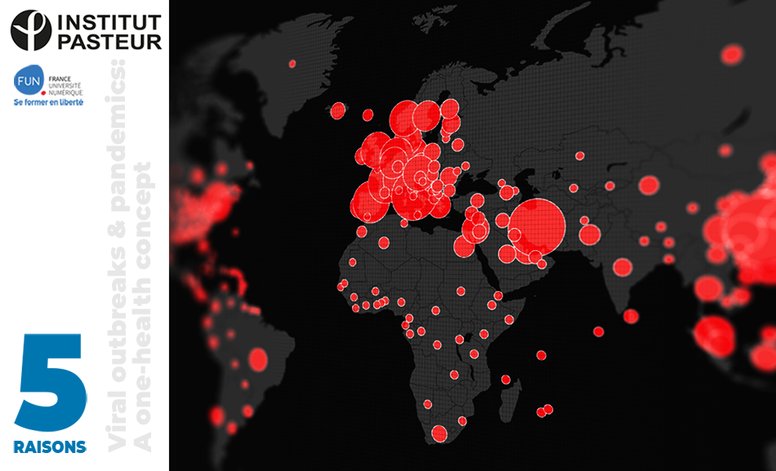
Find out why viral epidemics and pandemics are increasing and what measures are being taken to reduce their risk.
While we thought the risk of infectious diseases had practically disappeared with the advent of hygiene, antibiotics and vaccines, viral epidemics have multiplied in recent decades. The last one, COVID-19, responsible for 17 million deaths across the world with major social and economic consequences, has had a profound impact on people's minds. This development is not due to a relaxation of hygiene and anti-infectious medicine. It is most often linked to the transmission to humans of wild animal viruses. These emerging infectious diseases clearly illustrate the term “Global Health”, bringing together human, animals and environmental health.
Here are 5 important reasons to follow this MOOC :
Reason n°1
Be aware of the significant risk of transmission to humans of viruses from wild animal reservoirs, by direct contact or by insect vectors.
Reason n° 2
Understand the molecular mechanisms that facilitate the passage of these viruses to humans and then human-to-human transmission.
Reason n°3
Discover how population concentrations and the speed of international travels promote the dissemination of viral infections as soon as they emerge.
Reason n°4
Realize that climatic changes and the decrease of wildlife habitat bring closer humans and the wild world and increase the risk of zoonoses.
Reason n°5
Discover how to monitor and screen for emerging infections, identify pathogens, fight against their spread, and develop new vaccines and treatments.
To register and find out more, click here
Course start : February 13, 2024
End of registration : April 10, 2024
This training is part of the Digital Diploma in Infectious Diseases of the Institut Pasteur (DNM2IP). https://www.pasteur.fr/fr/DNM2IP
Related posts

Alimentation durable : comment semer les graines du changement ?
Categories
About the course
Plongée dans l'univers des tiers-lieux : découvrir, partager, collaborer
Categories
About the course
Comment enclencher une révolution verte ?
Categories
About the course