FUN MOOC
  • News
  • Courses
  • FormaPro
  • Organizations
  • About FUN
  • FAQ
  • You are here:
  • Home
  • News
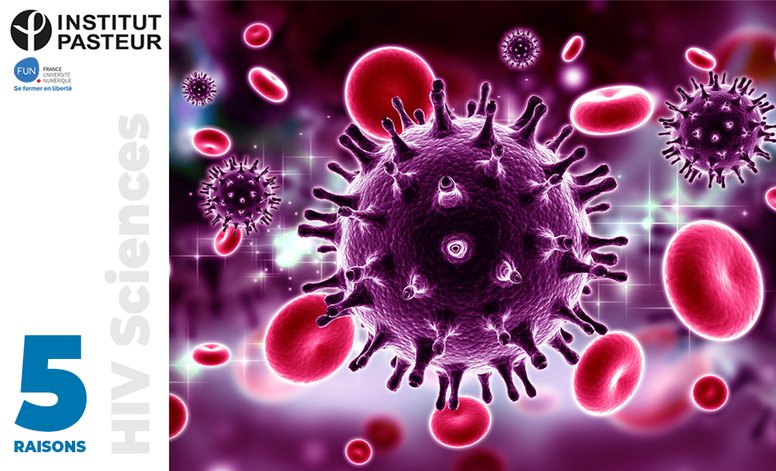
  • 5 reasons to take the HIV Sciences MOOC

5 reasons to take the HIV Sciences MOOC

Categories

About the course

10/29/2025

What is the origin of the HIV virus? What are the current prospects for the eradication of HIV? What are the latest advances in treatment and prevention?

Since the start of the epidemic, the human immunodeficiency virus (HIV) has infected more than 91 million people and caused over 40 million deaths.
Today, viral replication can be controlled thanks to antiretroviral treatment. However, HIV infection remains a major global public health challenge.
In 2024, there were still 40.8 million people living with HIV, 1.3 million new infections and about 630,000 deaths related to the disease, according to the WHO. More than 20% of infected people still do not have access to antiretroviral treatments.
To date, no curative treatment exists. Antiretroviral therapy, although effective at controlling the disease, must be continued for life.
In this online course, we will review the different aspects of HIV infection: from its biological origin and its identification as the causal agent of AIDS, to prospects for eradication. Overall, the course aims to provide a cross-cutting overview of the epidemic from the perspectives of scientists, clinicians and people living with HIV.
8 updated sessions and 2 new ones covering the latest on HIV epidemiology, care, and prevention, including innate immunity and vaccine history.

Here are five important reasons to take this course:

1 - To know the status of the HIV epidemic worldwide

In 2024, there were still 40.8 million people living with HIV, 1.3 million new infections and about 630,000 deaths related to the disease, according to the WHO. More than 20% of infected people still do not have access to antiretroviral treatments.

2 - Learn about the immune mechanisms that fight the virus

Immune mechanisms against HIV include innate immune cells (such as NK cells) and the adaptive response: cytotoxic CD8+ T cells that eliminate infected cells; CD4+ T cells that orchestrate the response; and B cells that produce neutralizing antibodies. Although these mechanisms can limit viral entry, the latent reservoir prevents eradication of HIV.

3 - Be aware of the existence of rare individuals who succeed in controlling the infection

A small number of people called "elite controllers", less than 1% of people living with HIV, spontaneously control viral replication. Despite this viral suppression, they may experience inflammation and other comorbidities.

4 - Learn more about the clinical management of HIV infection

The "test-and-treat" strategy: start effective antiretroviral triple therapy quickly, aim for an undetectable viral load (undetectable = untransmissible), and monitor treatment adherence, comorbidities and drug interactions.

5 - Discover the latest innovations and treatment and prevention prospects

New treatments involve long-acting options, such as injectable PrEP with cabotegravir every two months and lenacapavir every six months, as well as broadly neutralizing antibodies (bNAbs).

This MOOC is bilingual English-French.
It is part of the Institut Pasteur Online Diploma of Infectious Diseases (DNM2IP).

To learn more, click here
Institut Pasteur
Course: From November 4, 2025 to November 3, 2026
Enrollment: From September 4, 2025 to November 3, 2026

HIV Science

OrganizationInstitut Pasteur
Course code96011
CategoryCertificate
Course date Open for enrollment
This course offers a certification.The entire course can be completed without cost.

Michaela Müller-Trutwin

Categories

Michaela Müller-Trutwin is Associate Professor and the head of the “HIV, Inflammation and Persistence” Unit at Institut Pasteur, where she also directed the international PhD program.

Asier Sáez-Cirión

Categories

Asier Sáez-Cirión is Associate Professor at Institut Pasteur and Team Leader at the HIV, Inflammation and Persistence Unit.

Luis Romero Martin

Categories

Community Manager - Luis is a postdoctoral researcher at the Institut Pasteur with eight years of experience in the HIV field.

Related posts

5 raisons de s’inscrire au MOOC ConstruiREcycler

Categories

About the course

Autopsie d’un programme, au cœur du code  binaire

Categories

About the course

Développement durable : des filières qui innovent

Categories

About the course

Other categories of articles

FunctionalityAbout the course
FacebookTwitterLinkedin

Learn more

  • Help and contact
  • About FUN
  • Newsletters
  • Legal
  • Privacy policy
  • User's charter
  • General Terms and Conditions of Use
  • Sitemap
  • Cookie management
Logo FUN Mooc powered by Richie